
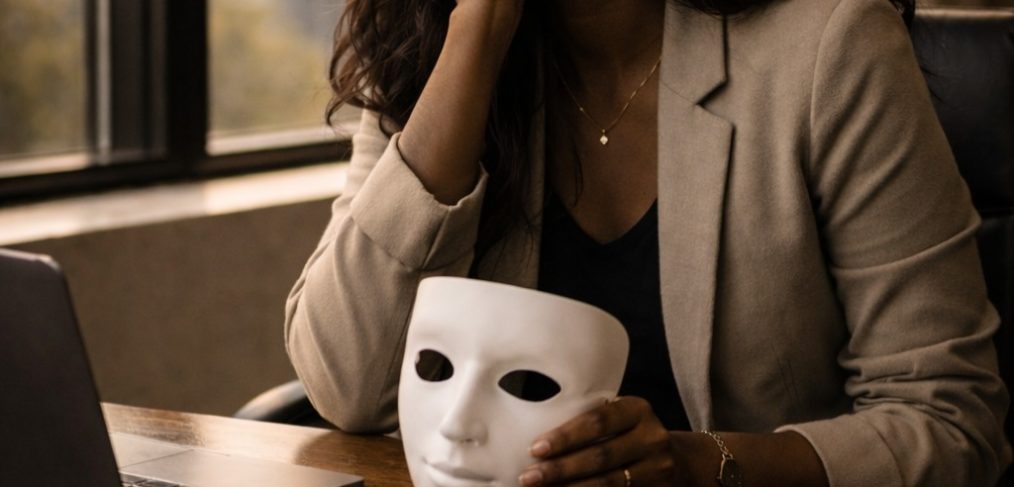
Imposter syndrome

Let’s talk about that weird, heavy feeling that creeps in even after you’ve done everything right. You get the job. You show up. You deliver. You’re literally doing the thing and still, a small voice in your head whispers: “You don’t belong here.” 

That is imposter syndrome. And let me tell you, it doesn’t matter how smart, qualified, or kind you are. It shows up anyway. Usually when you least expect it. 

So, what is imposter syndrome? 

Imposter syndrome is the internal experience of believing you’re not as competent as others think you are. It’s that uncomfortable feeling that you’re faking your way through life or work, and one day, people will find out you’re not really that smart, talented, or capable. Even though there’s no actual evidence to support those thoughts, imposter syndrome convinces you otherwise. It tricks you into downplaying your success and doubting your value. 

What imposter syndrome feels like (in real life): 

  • You second-guess every decision, even small ones like how to sign off an email. 
  • You overwork to “make up” for the fact that you don’t feel you are good enough. 
  • You minimize your achievements or chalk them up to luck. 
  • You feel like if people really knew you, they’d realize you’re not as competent as they think, or as your title or position may seem.   

And yet, you’ve earned your seat. Even if you sometimes feel unsure of how to sit in it. 

If you’re at the beginning of your career, fresh out of school, new to your field, or finally getting your first big opportunity, imposter syndrome can feel louder than ever. Because no one really prepares you for the identity shift that comes with stepping into a new role. One day, you’re a student or a job seeker. The next, you have a title, a team, expectations, and a work email and it all feels surreal. 

You might be thinking: 

  • “Why did they hire me?” 
  • “Am I smart enough to be here?” 
  • “Should I speak in this meeting or just keep nodding?” 
  • “Everyone else seems to know what they’re doing except me.” 

Let me say this clearly:
You’re not faking it. You’re just new to where you are now. 

Your brain is trying to protect you from failure, embarrassment, and rejection. It whispers, “Stay small. Don’t be seen. Don’t risk it.”  

Here is what I am learning slowly but surely: 

  • Growth requires being seen. It requires speaking up in the meeting even if your voice shakes a little. It requires sending the email. It requires applying for the opportunity. 
  • The people who seem “so sure of themselves” were once new too. They just kept showing up long enough for uncertainty to soften. Being new is uncomfortable because growth is uncomfortable. You are stretching into a version of yourself you have not fully met yet. Of course, it feels unfamiliar. That does not mean it is fake. 
  • Imposter syndrome thrives in silence. The less we talk about it, the more isolated we feel. The truth? So many high-achieving, thoughtful, capable people experience it. The intern. The manager. The founder. The person you admire. The one giving the presentation with steady hands might have rehearsed ten times because they were terrified of messing up. 

So how do we gently push back against imposter syndrome instead of letting it run our one life, our show? 

1. Remember: feelings are not facts 

Just because you feel behind does not mean you are.
Just because you feel underqualified does not mean you are.
Just because you feel unsure does not mean you are incapable. 

2. Celebrate small wins 

Imposter syndrome has a habit of moving the goalpost. If you only celebrate “big” achievements, you will always feel behind. Start acknowledging progress in real time. Keep a folder of positive feedback, successful project completions, and “thank you” emails.​ Look at this data when the “inner critic” gets too loud.​ 

3. Regularly ask for specific feedback 

Imposter syndrome feeds on assumptions: 

“So-and-so probably thinks I’m underperforming.”
“My manager must regret hiring me.” 

Instead of guessing, ask!

Schedule informal or formal check-ins with a trusted colleague, mentor, or manager. Ask: 

  • “What am I doing well?” 
  • “Where do you see growth for me?” 
  • “What skills should I focus on strengthening?” 

Clear, specific feedback grounds you in reality. It replaces vague fear with actionable direction. 

3. Invest in the person you’re becoming 

Continuous learning is a commitment to growth. When you focus on becoming better rather than being perfect, the pressure softens. You’re no longer trying to “prove” you belong. You’re actively growing into the role. 

A simple reframing can shift everything – instead of asking, “Do I belong here?” you can ask yourself, “What can I learn here?” 

Shift your focus from proving your worth to building your capacity. 

Take the course.
Read the book.
Ask the question.
Practice the skill. 

Finally, maybe the most important thing to reminder: 

You don’t overcome imposter syndrome by magically becoming more impressive. You overcome it by building a healthier relationship with yourself. And that is enough. 

So, if that little voice is louder at the moment, please hear this: 

You were not hired by accident. You were not chosen out of pity. You are not one mistake away from being exposed. 

You are growing. And growth rarely feels graceful. 

The next time that small voice whispers, “You don’t belong here”, you may gently answer back: “I may be new. I may still be learning. But I am not an imposter. I am in progress.” 


Author: Sonie Annick Akaliza, mHub Rwanda, 2026-26-02 

If you would like to reach out to speak to someone, please contact mHub by email: info@mhub-africa.org or call 0785-318416. 
The quiet balance of life

Today, I celebrated a life and mourned another. The irony of it all how one person rejoices at the gift of being born, surrounded by laughter and love, while elsewhere another is being wept for, their absence echoing through the hearts that once held them dear. Today was both joyful and sorrowful or perhaps, more truthfully, deeply reflective.

I didn’t know the person who passed away. I only attended the funeral because they were related to my friend. Yet, standing there, I came face to face with the quiet brutality of life the kind that I’ve only witnessed from the sidelines. The image of a woman losing her husband, a mother losing her children’s father. I looked around at my friends and saw pieces of us reflected in the late man’s children standing there, holding their mother as she spoke of the man she once loved. I was only three when my father died; I barely remember his face, his voice, or the world as it was then. And for context, most of my friends also lost their fathers when they were far too young to understand what loss really meant.

I didn’t want to make this tragedy about me. I simply wanted to understand this man through the stories of his friends and the words of his wife how she described him as present, gentle, and devoted partner and father. But somehow, I couldn’t help thinking of my own father. The things I know of him are secondhand stories owned by others, memories that don’t quite belong to me. I didn’t know either of them, yet somehow, they were the same, both are now absent, left early and loved deeply.

The truth is, I have no philosophy death after this. I don’t know what to tell someone who is trying to make sense of it. Should I say, live life fully, because tomorrow is never promised? Because this man, mind you, was preparing to celebrate ten years of marriage with his wife. There were plans beautiful, ordinary plans for a shared moment that they never knew would now never come. On the very day he died, she had only wanted them to spend it together as a family.

Perhaps the lesson is this: celebrate when you can, because you never truly know what waits beyond the next moment or day. People often repeat those phrases “Tell your loved ones you love them,” “Forgive while you can,” “Live life to the fullest.” And we roll our eyes because they sound like tired clichés. But at some point, clichés become truths we only understand too late. Still, what about the days when you simply cannot? When you have no energy to reach out, no peace to forgive, no spark to celebrate or even enjoy life? And what if, on some days, there is neither the reason nor the means to do any of it?

Death steals from us in ways we can’t anticipate, and we have no control over its choosing. I’ll probably forget the heaviness of today in a week or so, but I hope I never forget how sudden death is. I hope that when courage or opportunity finds me, I’ll choose to live fully, imperfectly even when I have no idea how it will unfold.

Remember how I said I celebrated a life today? That life belongs to my friend. She turned a year older, and for the first time since I’ve known her, I saw her slow down, truly savoring the day instead of racing past it. That alone brought me joy. So today, I witnessed both joy and pain life in its raw, unscripted balance.

Honestly, I don’t want to hold on to pain right now. I don’t want grudges or bad memories. I don’t want to see my mother carry her sorrow when I’m there to hold it with her. I don’t want to do wrong. I don’t want to complain about my day. I just don’t want to carry anything heavy anymore. I know I can only do so much, but I hope that whatever small good I manage will help me live better. And when my time comes, I hope to leave peacefully and that those I leave behind will feel that peace too.

I don’t even want to go too deep into what I felt about my faith today, but I questioned it. I questioned how these people, who had prayed so faithfully that their children would never be orphaned, now stood facing their worst fear. Yet, somehow, the man’s brother restored a piece of my faith when he said, “We want to blame God for taking you, but He’s the same one who gave you to us.” And maybe that’s what I’ll hold on to for now – the reminder that before there was loss, there was love, and the privilege and joy of having known it.

So, I see today not as a lesson, but as a reflection a quiet reminder that grief and gratitude co-exist, and that perhaps the truest way to live is to hold space for both.

Anonymous, Rwanda, October 2025

If you would like to reach out to speak to someone, please contact mHub on email: info@mhub-africa.org or call 0785-318416.

Talk about it if it keeps you here

Talk About It If It Keeps You Here

I was scrolling on TikTok the other day when I came across a video that made me pause, rewind, and listen again. A young woman was sharing a story from the night before. She had been at a bar, having one of those unexpectedly deep conversations with a stranger. The topic? Grief and mental health, two things that often walk side by side, though we rarely give them space in everyday conversations.

She told him, “I just feel like my friends are annoyed with me because it’s all I talk about lately. I feel like I talk about my loss too much.”

The stranger didn’t rush to comfort her with clichés or change the subject. Instead, he put his drink down, looked her straight in the eyes, and said:

“Talk about it if it keeps you here.”

She said she got goosebumps. Honestly, so did I.

Because how many of us have been there? Wanting to talk about our pain, but second-guessing ourselves. Wondering if we’re exhausting the people around us. Thinking, I’ve told this story already. Maybe I should just keep it to myself.

But here’s the thing: silence doesn’t always mean healing. Silence can sometimes mean isolation. And the truth is, there is no such thing as talking about your grief, your struggles, your loss too much. If speaking about it is what helps you survive another day, then speak. If sharing your story is what helps you breathe through the weight of it all, then share. A hundred times. A thousand times. Until you feel lighter.

As we begin Suicide Prevention Month, this video feels like the exact reminder we all need. That keeping people here, keeping you here, is worth more than anything else. And if words, conversations, and vulnerable honesty are the lifeline, then let them flow.

To those who are struggling right now: You are not a burden. You are not “too much.” Your presence matters more than you can possibly know. Please keep talking. Keep writing. Keep reaching out. The people who truly love you would rather hear the same story a hundred times than never hear your voice again.

To those standing beside someone who is hurting: It’s not easy. Sometimes you won’t know what to say. Sometimes you’ll feel helpless. That’s okay. What matters most is that you stay. That you listen. That you show up again and again, even in small ways. You don’t need to fix their pain, you only need to remind them they are not walking through it alone.

To those who have lost someone to suicide: There are no words big enough for your grief. The hole left behind can feel endless, and the questions without answers can weigh so heavily. Please know your grief is valid. Talking about your loved one, missing them out loud, honoring their story, this is not “too much.” It is love refusing to be silent.

This month is not only about preventing loss, it is about building compassion. It is about reminding ourselves and each other that the human heart was not designed to carry everything in silence. Talking about mental health, grief, and pain is not weakness, it is survival.

So if you need to cry, cry. If you need to scream, scream. If you need to tell the same story again and again, tell it. Do whatever keeps you here.

And for those of us listening: let’s not measure patience by the number of times we’ve heard the story. Let’s measure love by the fact that we’re still here, still listening, still holding space.

The stranger at the bar was right. Words can keep us alive. Connection can keep us alive.

So please, talk about it if it keeps you here.
We are listening. We are with you. Always.

Special shout out to @laurenjnicole on TikTok, you are a gem.

Author: Sonie Annick Akaliza, mHub Rwanda, 2025-09-01

If you would like to reach out to speak to someone, please contact mHub on email: info@mhub-africa.org or call 0785-318416.

The power of finding meaning

What is the meaning of life? It is a question that has been subject of debate for centuries. It is certainly not a question that I have the answer to. However, I am slowly discovering what gives my life meaning. Insignificant as that may sound, I find it remarkably powerful.

When I was admitted to the flight academy to become an airline pilot, nearly 25 years ago, a childhood dream came true. However, from the start of my career something felt off. I was struggling to find my way, I felt stressed and purposeless. Once I realized that my dream hadn’t turned out exactly as I had imagined it, I started to look for help. Most of the professional help I received was aimed at working on my weaknesses, to deal with the challenges of the job. Did it help? To some extend. I was able to function, but I wasn’t exactly thriving.

Things changed after I was introduced to the field of positive psychology (Seligman & Csikszentmihalyi, 2000). As opposed to traditional psychology, which focuses on what’s wrong, positive psychology asks: ‘What makes life worth living?’. It focuses on talents, passions, core values and finding meaning, and gives guidance on how to live a happy and fulfilling life. Getting my core values and passions clear helped me find some direction and meaning in my life, and it led to significant changes.

Writing this blog, I have recently left my old job and am doing an internship at mHub – Rwanda. I am surrounded by people with whom I share core values and passions. I feel like I am contributing to something that is important to me: helping others improve their mental health. And it gives me a sense of meaning and belonging. Does that mean there are no difficulties? Certainly not: work can still be stressful, challenging, tiring. But there is an important difference: working on something that gives my life meaning makes it worth it, and I am feeling quite happy doing so.

Another testimony to the value of meaning is the story of Alain, a former drug user whom I met here in Rwanda, who turned his negative life experience into something positive. With his organisation, STEPS Initiative, he raises awareness on mental health issues and addiction among adolescents. Sharing his life experience gives a positive meaning to the struggles he had to go through, while being able to contribute to others gives him a sense of purpose. His remarkable comeback from a seemingly hopeless situation into a passionate and dedicated expert, is a strong illustration of the power of meaning.

These examples show that positive psychology has a lot of potential. Focussing on your talents and passions helps you to not just endure life, but to flourish. And finding meaning can increase feelings of fulfillment, happiness and life satisfaction. These positive states of mind help you endure the hardships that, inevitably, are also part of life.

So, take a moment to reflect on your passions, values, and what gives meaning to your life. Allow it to give you direction. A fulfilling future lies ahead.

Author: Jöran Schakenraad,  mHub intern, 1 August 2025

Literature

Seligman, M. E. P., & Csikszentmihalyi, M. (2000). Positive Psychology: An Introduction. American Psychologist, 55(1), 5-14.

Breaking the chains

Prevention, treatment, and recovery for all!

In every corner of our beautiful Rwanda, lives are full of promise. Our communities are strong, our youth are talented, and our future is bright. Yet, like many places around the world, we are also facing a silent challenge that continues to affect individuals and families alike: the growing burden of drug and substance abuse.

This June, in partnership with the Rwanda Biomedical Centre (RBC) and STEPS Initiative, we are launching a powerful and inclusive campaign under the theme: “Breaking the Chains: Prevention, Treatment, and Recovery for All!” This initiative is not just about raising awareness. It is about standing together as a nation to say “no” to stigma and “yes” to support, healing, and hope.

A crisis that needs everyone’s engagement and time

Drug abuse is not a matter of moral failure. It is a complex issue that can touch anyone, young or old, rich or poor, rural or urban. Whether it’s out of curiosity, peer pressure, trauma, or mental health challenges, the reasons people turn to drugs are deeply human. And so, our response must also be deeply human.

We must move beyond blame and judgment. We must listen. We must support. We must open the doors to education, to treatment, and to second chances.

Behind each case is a story, many of them rooted in hardship. Young people are not just looking for a high. Many are looking for a way out of emotional or social pain. Poverty, trauma, unemployment, or peer pressure, these are just some of the forces that push them toward drugs. But what begins as a way to cope often becomes a trap – one that is excruciatingly hard to escape from without help.

Addiction Is not a choice, it’s an illness

It’s easy to judge. It’s easy to say someone just needs more discipline or stronger morals. But addiction is not that simple.

Addiction is a chronic illness, a medical condition that changes the brain and affects behavior. It affects decision-making, emotional control, and physical health. And like any illness, it can most certainly not be solved with shame. It requires treatment, support, education, patience, understanding, and time.

Sadly, many of our brothers and sisters battling addiction never receive that help. Not because they don’t want it, but because they’re afraid. Afraid of being labeled, rejected, or punished. This fear leads to silence. That silence leads to suffering.

The power of community and change

Thankfully, Rwanda has begun to shift the narrative. We are moving away from viewing addiction as a crime or moral failure, and instead, embracing the as the public health issue it is.

Treatment centers like the Icyizere Psychotherapeutic Centre are already offering counseling and rehabilitation. Schools are starting to include drug education, and health workers are being trained to support people with substance use disorders, not just treat their symptoms, but walk with them through recovery.

But the most powerful change happens not in institutions, but in communities. Healing happens in homes, in churches, in youth groups, in families. When someone struggling with addiction is met with understanding instead of judgment, their path to recovery becomes real.

Prevention begins with us

The best way to fight addiction is to prevent it before it begins. That starts with education and knowledge. It starts with talking to our children, creating safe spaces where they feel heard. It starts in classrooms and living rooms, where young people are given the tools and guidance to make healthy decisions during times of adversity and struggle.

Every Rwandan has a role to play:

  • Parents, talk to your children before the streets do.
  • Teachers, look for the signs and act with care.
  • Youth, be brave enough to choose a different path, and help your friends do the same.
  • Faith and community leaders, be a voice of compassion and strength.

Recovery is real, and it belongs to everyone

To anyone struggling with substance use: You are not alone. Recovery is possible. You are not your addiction. You are a valued person with dignity, a future, and a role in society.

Getting help is not weakness. It is courage. And no one should have to walk the path to recovery by themselves.

We must stand together and create a Rwanda where recovery is seen as a human right, not a privilege. Where support is within reach, and no one is too far gone to be welcomed back.

Real stories, real hope

Across Rwanda, there are stories that inspire. Stories of young men and women who were once trapped by drugs, but with the help of their families, communities, and faith, they came back. They are now studying, working, leading, and giving back.

These stories are not miracles, they are proof. Proof that with the right support, anyone can rise above addiction. That’s why this campaign matters. Because it shows us that change is possible when we come together.

What will you do?

You don’t need to wear a uniform or have a title to make a difference.

You can:

  • Learn the signs of addiction and share accurate information.
  • Talk to your children or siblings today, not tomorrow.
  • Support someone who is trying to recover.
  • Speak up against stigma when you hear it.
  • Choose kindness every time.

Behind every addiction is a human being. And behind every recovery is a community that chose to care.

Together, we can break the chains

This year’s anti-drug campaign is not just a warning. It is a promise, a promise to build a Rwanda that is healthier, more compassionate, and more united than ever.

As we launch this campaign on June 16th, we invite you to reflect on this:

  • What part will I play?
  • Whose story can I change?
  • How can my kindness, time, or voice be part of someone’s healing?

Let us break the chains of stigma, silence, and despair.

Let us build a future where prevention, treatment, and recovery are not just policies, but promises for all.

Together, we rise. Together, we heal. Together, we break the chains.

Author: Sonie Annick Akaliza, mHub Rwanda, 2025-06-23

For further information about addiction treatment and prevention, please contact mHub on email: info@mhub-africa.org or call 0785-318416.